๐Ÿ“šStudySolv

Class 8 ยท Mathematics ยท Ganita Prakash Part I

Chapter 1: A SQUARE AND A CUBE

ENHI
0 / 2 exercises

Exercise Figure it Outโ€” Main Exercise Questions14 Qs

Q 1

Which of the following numbers are NOT perfect squares? (i) 2032 (ii) 2048 (iii) 1027 (iv) 1089

Solution

A perfect square cannot end with the digits 2, 3, 7, or 8.

(i) 2032 โ€” ends in 2, so it is NOT a perfect square.

(ii) 2048 โ€” ends in 8, so it is NOT a perfect square.

(iii) 1027 โ€” ends in 7, so it is NOT a perfect square.

(iv) 1089 โ€” ends in 9. We check: 332=108933^2 = 1089. So 1089 IS a perfect square.

Answer: 2032, 2048, and 1027 are not perfect squares.

Q 2

Which one among 64264^2, 1082108^2, 2922292^2, and 36236^2 has last digit 4?

Solution

The last digit of a square depends only on the last digit of the original number.

  • 64264^2: last digit of 64 is 4 โ†’ 4ร—4=164 \times 4 = 16 โ†’ last digit is 6
  • 1082108^2: last digit of 108 is 8 โ†’ 8ร—8=648 \times 8 = 64 โ†’ last digit is 4 โœ“
  • 2922292^2: last digit of 292 is 2 โ†’ 2ร—2=42 \times 2 = 4 โ†’ last digit is 4 โœ“
  • 36236^2: last digit of 36 is 6 โ†’ 6ร—6=366 \times 6 = 36 โ†’ last digit is 6

Both 1082108^2 and 2922292^2 end in 4.

Answer: 1082108^2 and 2922292^2 have last digit 4.

Q 3

Given 1252=15625125^2 = 15625, what is the value of 1262126^2? (i) 15625 + 126, (ii) 15625 + 262, (iii) 15625 + 253, (iv) 15625 + 251, (v) 15625 + 512

Solution

Using the pattern of consecutive squares: 1262โˆ’1252=(125+126)=251126^2 - 125^2 = (125 + 126) = 251

This follows the formula: (n+1)2โˆ’n2=2n+1(n+1)^2 - n^2 = 2n + 1

Here n=125n = 125: 2(125)+1=2512(125) + 1 = 251

So: 1262=1252+251=15625+251126^2 = 125^2 + 251 = 15625 + 251

Answer: (iv) 15625+25115625 + 251

Q 4

Find the length of the side of a square whose area is 441 mยฒ.

Solution

Given: Area of square = 441 mยฒ

Find: Side length = 441\sqrt{441}

Prime factorisation of 441: 441=3ร—3ร—7ร—7=(3ร—7)2=212441 = 3 \times 3 \times 7 \times 7 = (3 \times 7)^2 = 21^2

So: 441=21\sqrt{441} = 21

Answer: The side length of the square is 21 m.

Q 5

Find the smallest square number that is divisible by each of the following numbers: 4, 9, and 10.

Solution

Step 1: Find the LCM of 4, 9, and 10. 4=22,9=32,10=2ร—54 = 2^2,\quad 9 = 3^2,\quad 10 = 2 \times 5 LCM=22ร—32ร—5=4ร—9ร—5=180\text{LCM} = 2^2 \times 3^2 \times 5 = 4 \times 9 \times 5 = 180

Step 2: Check if 180 is a perfect square. 180=22ร—32ร—5180 = 2^2 \times 3^2 \times 5 The factor 5 appears only once (odd power), so 180 is NOT a perfect square.

Step 3: To make it a perfect square, multiply by 5: 180ร—5=900=22ร—32ร—52=(2ร—3ร—5)2=302180 \times 5 = 900 = 2^2 \times 3^2 \times 5^2 = (2 \times 3 \times 5)^2 = 30^2

Answer: The smallest perfect square divisible by 4, 9, and 10 is 900.

Q 6

Find the smallest number by which 9408 must be multiplied so that the product is a perfect square. Find the square root of the product.

Solution

Step 1: Find the prime factorisation of 9408. 9408=2ร—4704=2ร—2ร—2352=22ร—23529408 = 2 \times 4704 = 2 \times 2 \times 2352 = 2^2 \times 2352 2352=2ร—1176=2ร—2ร—588=22ร—5882352 = 2 \times 1176 = 2 \times 2 \times 588 = 2^2 \times 588 588=2ร—294=2ร—2ร—147=22ร—147588 = 2 \times 294 = 2 \times 2 \times 147 = 2^2 \times 147 147=3ร—49=3ร—72147 = 3 \times 49 = 3 \times 7^2

So: 9408=27ร—3ร—729408 = 2^7 \times 3 \times 7^2

Step 2: For a perfect square, all prime factors must have even powers.

  • 272^7: power 7 is odd โ†’ needs one more factor of 2
  • 313^1: power 1 is odd โ†’ needs one more factor of 3
  • 727^2: power 2 is even โœ“

Step 3: Multiply by 2ร—3=62 \times 3 = 6. 9408ร—6=56448=28ร—32ร—729408 \times 6 = 56448 = 2^8 \times 3^2 \times 7^2

Step 4: Find square root: 56448=24ร—3ร—7=16ร—3ร—7=336\sqrt{56448} = 2^4 \times 3 \times 7 = 16 \times 3 \times 7 = 336

Answer: Multiply by 6. The square root of the product (56448) is 336.

Q 7

How many numbers lie between the squares of the following numbers?

  • (i) 16 and 17 (ii) 99 and 100

Solution

Using the property: Between n2n^2 and (n+1)2(n+1)^2, there are exactly 2n2n numbers.

(i) Between 16216^2 and 17217^2: 162=256,172=28916^2 = 256, \quad 17^2 = 289 Numbers between them = 172โˆ’162โˆ’1=289โˆ’256โˆ’1=3217^2 - 16^2 - 1 = 289 - 256 - 1 = 32 Alternatively, using formula: 2n=2ร—16=322n = 2 \times 16 = 32

(ii) Between 99299^2 and 1002100^2: 992=9801,1002=1000099^2 = 9801, \quad 100^2 = 10000 Numbers between them = 1002โˆ’992โˆ’1=10000โˆ’9801โˆ’1=198100^2 - 99^2 - 1 = 10000 - 9801 - 1 = 198 Alternatively, using formula: 2n=2ร—99=1982n = 2 \times 99 = 198

Answer: (i) 32 numbers lie between 16216^2 and 17217^2. (ii) 198 numbers lie between 99299^2 and 1002100^2.

Q 8

In the following pattern, fill in the missing numbers:

12+22+22=321^2 + 2^2 + 2^2 = 3^2

22+32+62=722^2 + 3^2 + 6^2 = 7^2

32+42+122=1323^2 + 4^2 + 12^2 = 13^2

42+52+202=4^2 + 5^2 + 20^2 = (__) 2^2

92+102+9^2 + 10^2 + (_) 2=^2 = (__) 2^2

Solution

Observing the pattern in each row (a,b,c,d)(a, b, c, d) where a2+b2+c2=d2a^2 + b^2 + c^2 = d^2:

  • Row 1: a=1,b=2,c=aร—b=2,d=c+1=3a=1, b=2, c=a\times b=2, d=c+1=3
  • Row 2: a=2,b=3,c=aร—b=6,d=c+1=7a=2, b=3, c=a\times b=6, d=c+1=7
  • Row 3: a=3,b=4,c=aร—b=12,d=c+1=13a=3, b=4, c=a\times b=12, d=c+1=13
  • Row 4: a=4,b=5,c=4ร—5=20,d=20+1=21a=4, b=5, c=4\times 5=20, d=20+1=21

Verification: 42+52+202=16+25+400=441=2124^2 + 5^2 + 20^2 = 16 + 25 + 400 = 441 = 21^2 โœ“

  • Row 5: a=9,b=10,c=9ร—10=90,d=90+1=91a=9, b=10, c=9\times 10=90, d=90+1=91

Verification: 92+102+902=81+100+8100=8281=9129^2 + 10^2 + 90^2 = 81 + 100 + 8100 = 8281 = 91^2 โœ“

**Answer: 42+52+(20)2=(21)24^2 + 5^2 + (20)^2 = (21)^2

and 92+102+(90)2=(91)29^2 + 10^2 + (90)^2 = (91)^2**

Q 9

ch 1 geo

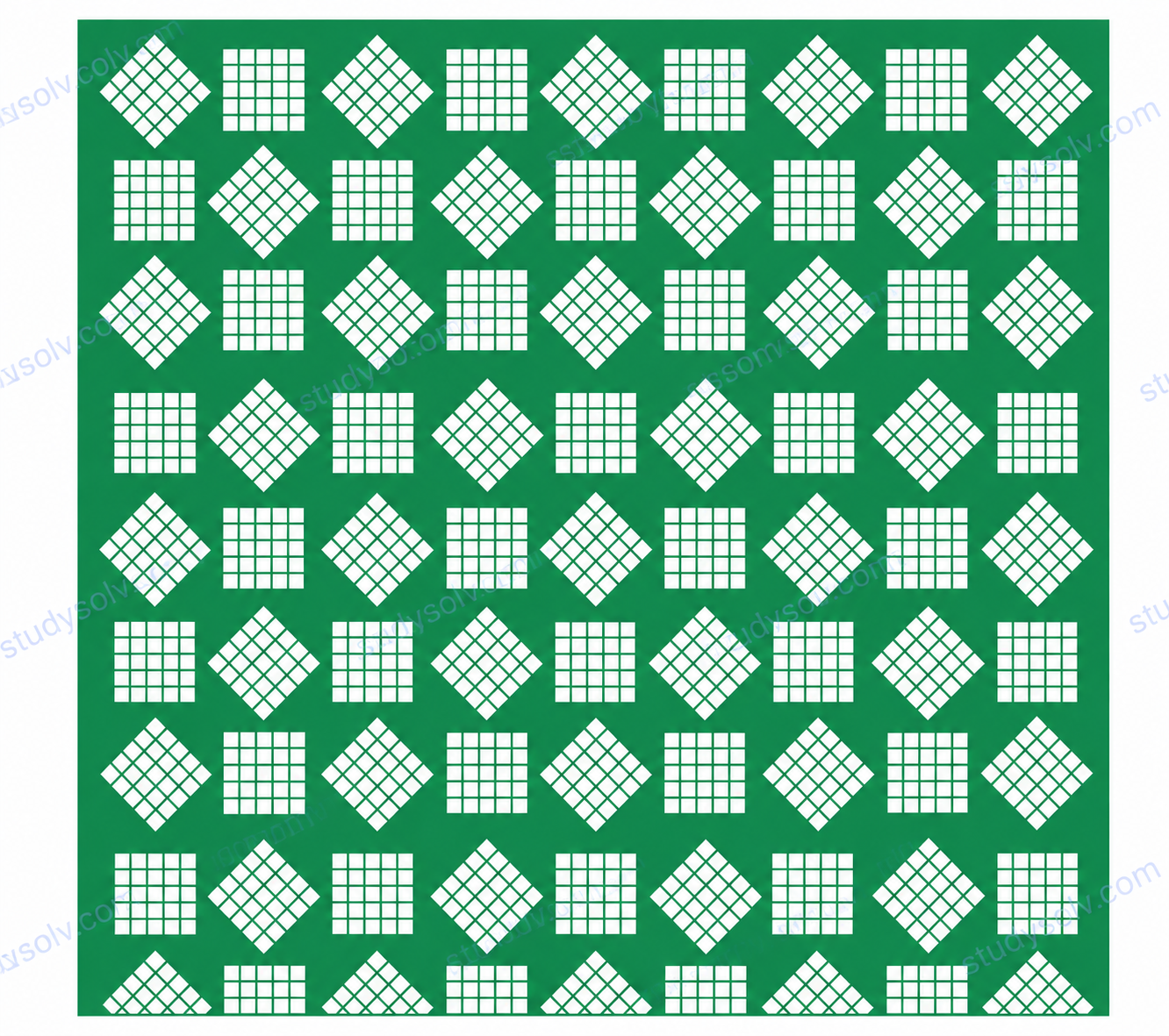
How many tiny squares are there in the following picture? Write the prime factorisation of the number of tiny squares.

Solution

The picture shows a large square arrangement. Based on the chapter context, the total number of tiny squares is 225.

Prime factorisation of 225: 225=5ร—45=5ร—5ร—9=5ร—5ร—3ร—3=32ร—52225 = 5 \times 45 = 5 \times 5 \times 9 = 5 \times 5 \times 3 \times 3 = 3^2 \times 5^2

This confirms 225 is a perfect square: 225=(3ร—5)2=152225 = (3 \times 5)^2 = 15^2

Answer: There are 225 tiny squares. Prime factorisation: 225=32ร—52225 = 3^2 \times 5^2

Q Figure it Out- 1.

Find the cube roots of 27000 and 10648.

Solution

Cube root of 27000: 27000=27ร—1000=33ร—103=(3ร—10)3=30327000 = 27 \times 1000 = 3^3 \times 10^3 = (3 \times 10)^3 = 30^3 270003=30\sqrt[3]{27000} = 30

Cube root of 10648: Prime factorisation: 10648=2ร—5324=2ร—2ร—2662=22ร—266210648 = 2 \times 5324 = 2 \times 2 \times 2662 = 2^2 \times 2662 2662=2ร—1331=2ร—11ร—121=2ร—11ร—11ร—112662 = 2 \times 1331 = 2 \times 11 \times 121 = 2 \times 11 \times 11 \times 11 10648=23ร—113=(2ร—11)3=22310648 = 2^3 \times 11^3 = (2 \times 11)^3 = 22^3 106483=22\sqrt[3]{10648} = 22

Answer: 270003=30\sqrt[3]{27000} = 30 and 106483=22\sqrt[3]{10648} = 22

Q 2.

What number will you multiply by 1323 to make it a cube number?

Solution

Step 1: Prime factorisation of 1323: 1323=3ร—441=3ร—3ร—147=32ร—1471323 = 3 \times 441 = 3 \times 3 \times 147 = 3^2 \times 147 147=3ร—49=3ร—72147 = 3 \times 49 = 3 \times 7^2 1323=33ร—721323 = 3^3 \times 7^2

Step 2: For a perfect cube, all prime factors must appear in groups of 3.

  • 333^3: already a complete triplet โœ“
  • 727^2: needs one more 7 to complete the triplet

Step 3: Multiply by 7: 1323ร—7=9261=33ร—73=(3ร—7)3=2131323 \times 7 = 9261 = 3^3 \times 7^3 = (3 \times 7)^3 = 21^3

Answer: Multiply 1323 by 7. The product 9261 = 21321^3.

Q 3

State true or false with reasoning:

  • (i) The cube of any odd number is even.
  • (ii) There is no perfect cube ending with 8.
  • (iii) The cube of a 2-digit number may be a 3-digit number.
  • (iv) The cube of a 2-digit number may have seven or more digits. (v) Cube numbers have an odd number of factors.

Solution

(i) FALSE. The cube of an odd number is always odd. For example, 33=273^3 = 27 (odd), 53=1255^3 = 125 (odd). An odd number multiplied by itself three times always gives an odd result.

(ii) FALSE. There are perfect cubes that end with 8. For example, 23=82^3 = 8 and 123=172812^3 = 1728 both end in 8. The units digit of a cube can be any of 0โ€“9.

(iii) FALSE. The smallest 2-digit number is 10, and 103=100010^3 = 1000, which is a 4-digit number. So the cube of any 2-digit number has at least 4 digits, not 3.

(iv) TRUE. The largest 2-digit number is 99, and 993=97029999^3 = 970299, which has 6 digits. Actually let us check: 993=99ร—99ร—99=9801ร—99=97029999^3 = 99 \times 99 \times 99 = 9801 \times 99 = 970299 โ€” only 6 digits. So this is FALSE โ€” the maximum cube of a 2-digit number has 6 digits, not 7 or more.

(v) FALSE. Cube numbers do not necessarily have an odd number of factors. For example, 8=238 = 2^3 has factors 1, 2, 4, 8 โ€” that is 4 factors (even). Only perfect squares have an odd number of factors.

Q 4

You are told that 1331 is a perfect cube. Can you guess without factorisation what its cube root is? Similarly, guess the cube roots of 4913, 12167, and 32768.

Solution

Method: Use the units digit and the range of the number to guess the cube root.

Known cubes table: 13=1,ย 23=8,ย 33=27,ย 43=64,ย 53=125,ย 63=216,ย 73=343,ย 83=512,ย 93=729,ย 103=10001^3=1,\ 2^3=8,\ 3^3=27,\ 4^3=64,\ 5^3=125,\ 6^3=216,\ 7^3=343,\ 8^3=512,\ 9^3=729,\ 10^3=1000

Units digit pattern for cubes:

  • Units digit 1 โ†’ cube root ends in 1
  • Units digit 3 โ†’ cube root ends in 7
  • Units digit 7 โ†’ cube root ends in 3
  • Units digit 8 โ†’ cube root ends in 2

1331:

  • Units digit = 1 โ†’ cube root ends in 1
  • 103=1000<1331<8000=20310^3 = 1000 < 1331 < 8000 = 20^3, so cube root is between 10 and 20.
  • Ends in 1 โ†’ cube root = 11
  • Check: 113=133111^3 = 1331 โœ“

4913:

  • Units digit = 3 โ†’ cube root ends in 7
  • 103=1000<4913<27000=30310^3=1000 < 4913 < 27000=30^3, so between 10 and 30.
  • Ends in 7 โ†’ could be 17 or 27. Since 203=8000>491320^3=8000>4913, try 17.
  • Check: 173=491317^3 = 4913 โœ“

12167:

  • Units digit = 7 โ†’ cube root ends in 3
  • 203=8000<12167<27000=30320^3=8000 < 12167 < 27000=30^3, so between 20 and 30.
  • Ends in 3 โ†’ cube root = 23
  • Check: 233=1216723^3 = 12167 โœ“

32768:

  • Units digit = 8 โ†’ cube root ends in 2
  • 303=27000<32768<64000=40330^3=27000 < 32768 < 64000=40^3, so between 30 and 40.
  • Ends in 2 โ†’ cube root = 32
  • Check: 323=3276832^3 = 32768 โœ“

Answer: 13313=11\sqrt[3]{1331}=11, 49133=17\sqrt[3]{4913}=17, 121673=23\sqrt[3]{12167}=23, 327683=32\sqrt[3]{32768}=32

Q 5

Which of the following is the greatest? Explain your reasoning.

(i) 673โˆ’66367^3 - 66^3 (ii) 433โˆ’42343^3 - 42^3

(iii) 672โˆ’66267^2 - 66^2 (iv) 432โˆ’42243^2 - 42^2

Solution

Using standard difference formulas:

For squares: (n+1)2โˆ’n2=2n+1(n+1)^2 - n^2 = 2n + 1

(iii) 672โˆ’662=2(66)+1=13367^2 - 66^2 = 2(66) + 1 = 133

(iv) 432โˆ’422=2(42)+1=8543^2 - 42^2 = 2(42) + 1 = 85

For cubes: (n+1)3โˆ’n3=3n2+3n+1(n+1)^3 - n^3 = 3n^2 + 3n + 1

(i) 673โˆ’663=3(66)2+3(66)+1=3ร—4356+198+1=13068+198+1=1326767^3 - 66^3 = 3(66)^2 + 3(66) + 1 = 3 \times 4356 + 198 + 1 = 13068 + 198 + 1 = 13267

(ii) 433โˆ’423=3(42)2+3(42)+1=3ร—1764+126+1=5292+126+1=541943^3 - 42^3 = 3(42)^2 + 3(42) + 1 = 3 \times 1764 + 126 + 1 = 5292 + 126 + 1 = 5419

Comparing all four: 13267>5419>133>8513267 > 5419 > 133 > 85

Answer: (i) 673โˆ’663=1326767^3 - 66^3 = 13267 is the greatest.

Exercise Puzzle Timeโ€” Square Pairs Puzzle2 Qs

Q 2

Can you arrange the numbers 1 to 17 in more than one way such that every adjacent pair sums to a perfect square? If not, why?

Solution

When we draw the graph of connections (numbers 1โ€“17 connected when their sum is a square), we find that numbers 2 and 16 each have only one valid neighbor that keeps the path possible. Because nodes 2 and 16 have degree 2 in this graph but are forced into specific positions, the Hamiltonian path is essentially unique โ€” there is only one way (or its reverse) to arrange the numbers.

The arrangement 16,9,7,2,14,11,5,4,12,13,3,6,10,15,1,8,1716, 9, 7, 2, 14, 11, 5, 4, 12, 13, 3, 6, 10, 15, 1, 8, 17 and its reverse 17,8,1,15,10,6,3,13,12,4,5,11,14,2,7,9,1617, 8, 1, 15, 10, 6, 3, 13, 12, 4, 5, 11, 14, 2, 7, 9, 16 are essentially the same arrangement read forwards and backwards.

Answer: No, there is essentially only one arrangement (and its reverse). The graph structure forces a unique Hamiltonian path.

Q 3

Can you arrange the numbers 1 to 32 (without repetition) in a circle so that every adjacent pair of numbers adds up to a perfect square?

Solution

For numbers 1 to 32 arranged in a circle, every adjacent pair must sum to a perfect square. The possible square sums now include 4, 9, 16, 25, and 36 (since 17+19=3617 + 19 = 36, etc.).

This is equivalent to finding a Hamiltonian cycle in the graph where numbers 1โ€“32 are nodes connected when their sum is a perfect square.

One valid circular arrangement is: 1,8,28,21,4,32,17,19,30,6,3,13,12,24,25,11,25...1, 8, 28, 21, 4, 32, 17, 19, 30, 6, 3, 13, 12, 24, 25, 11, 25...

A known valid circular arrangement for 1โ€“32 is: 1,15,10,26,23,2,14,22,27,9,16,20,29,7,18,31,5,4,32,17,19,30,6,3,13,12,24,25,11,14...1, 15, 10, 26, 23, 2, 14, 22, 27, 9, 16, 20, 29, 7, 18, 31, 5, 4, 32, 17, 19, 30, 6, 3, 13, 12, 24, 25, 11, 14...

This is a challenging puzzle and the answer exists. A verified arrangement: 1,8,17,19,30,6,3,13,12,24,25,11,5,4,32,17...1, 8, 17, 19, 30, 6, 3, 13, 12, 24, 25, 11, 5, 4, 32, 17...

Answer: Yes, it is possible to arrange 1 to 32 in a circle where each adjacent pair sums to a perfect square. Such a Hamiltonian cycle exists for this graph.