Class 8 · Social Science · Exploring Society India and Beyond Part-I
Chapter 4 Important Questions: The Colonial Era in India
1 Mark24 questions
Which European explorer first arrived at Kappad (near Kozhikode, Kerala) in 1498, paving the way for European colonisation in India?
(a) Christopher Columbus
(b) Ferdinand Magellan
(c) Vasco da Gama
(d) Francis Drake
The Battle of Plassey (1757) was a victory for the British East India Company against which ruler?
(a) Hyder Ali
(b) Tipu Sultan
(c) Siraj-ud-daulah
(d) Bahadur Shah Zafar
The Goa Inquisition, established by the Portuguese in 1560, was finally abolished in which year?
(a) 1757
(b) 1800
(c) 1812
(d) 1858
The Doctrine of Lapse, introduced by the British East India Company, stated that a princely state would be annexed if:
(a) The ruler refused to pay taxes
(b) The ruler died without a natural male heir
(c) The state had fewer than 500 soldiers
(d) The ruler allied with the French
Which battle in 1741 marked the decisive defeat of the Dutch by Travancore, making it a rare instance of an Asian power repelling a European colonial force?
(a) Battle of Plassey
(b) Battle of Buxar
(c) Battle of Colachel
(d) Battle of Wandiwash
According to historian Utsa Patnaik's estimate, approximately how much wealth did Britain extract from India between 1765 and 1938 (in today's value)?
(a) 1 trillion U.S. dollars
(b) 10 trillion U.S. dollars
(c) 45 trillion U.S. dollars
(d) 100 trillion U.S. dollars
Thomas Macaulay's 1835 'Minute on Indian Education' aimed to create a class of Indians who would be:
(a) Trained in Sanskrit and Arabic scholarship
(b) Independent of British rule
(c) Indian in blood but English in taste, opinions, morals and intellect
(d) Skilled in traditional weaving and crafts
The Santhal Rebellion of 1855–1856 was led by which two brothers?
(a) Birsa and Budhu Munda
(b) Sidhu and Kanhu Murmu
(c) Tilka and Jantri Majhi
(d) Kol and Oraon chiefs
Dadabhai Naoroji's 1901 book, which compiled the wealth drained out of India, was titled:
(a) Economic History of India
(b) Poverty and Un-British Rule in India
(c) The Wealth of Nations
(d) Discovery of India
Which of the following correctly describes the Portuguese system of 'cartaz'?
(a) A tax collected from Indian farmers on their land
(b) A permit that all ships in the Arabian Sea had to purchase from the Portuguese for navigation
(c) A military alliance formed between Portuguese and Indian rulers
(d) A religious tribunal set up to convert Indians to Christianity
The French Governor-General ___ pioneered the strategy of training Indian soldiers (sepoys) in European military techniques and using puppet rulers to extend French influence in India.
The Great Bengal Famine of 1770–1772 killed approximately ___ million people, nearly one-third of Bengal's population.
The song 'Vande Mātaram', which inspired India's freedom struggle, was part of the Bengali novel ___ written by Bankim Chandra Chattopadhyay in 1882.
The policy known as ___ allowed the British to control vast territories by installing a British 'Resident' in the courts of Indian rulers, who had to maintain British troops at their own expense.
India contributed at least ___ of the world GDP from ancient times until the 16th century CE, making it one of the two largest economies in the world alongside China.
The Dutch East India Company focused primarily on religious conversion and the destruction of Hindu temples, similar to the Portuguese approach in Goa.
The Indian Railways built during British rule were primarily designed to serve the needs and welfare of the Indian people.
The Battle of Plassey in 1757 was won by the British East India Company partly because Mir Jafar, the Nawab's military commander, betrayed Siraj-ud-daulah.
Famines on the massive scale seen during British rule had always occurred throughout Indian history at the same frequency and severity.
Rani Lakshmibai of Jhansi was captured alive by the British and later imprisoned after her defeat.
Match Column A with Column B:
| Column A: | Column B: |
|---|---|
| (i) Cartaz system | (a) Installing British Residents in Indian courts at Indian rulers' expense |
| (ii) Doctrine of Lapse | (b) Annexing states whose rulers died without a natural male heir |
| (iii) Subsidiary Alliance | (c) Portuguese naval permit system for ships in the Arabian Sea |
| (iv) Divide and Rule | (d) Exploiting rivalries and tensions between Indian rulers and communities |
Match Column A with Column B:
| Column A: | Column B: |
|---|---|
| (i) Dadabhai Naoroji | (a) King of Travancore who defeated the Dutch at Colachel |
| (ii) Bankim Chandra Chattopadhyay | (b) Author of Anandamath and 'Vande Mātaram' |
| (iii) Mangal Pandey | (c) Sepoy at Barrackpore who attacked British officers in 1857 |
| (iv) Marthanda Varma | (d) Author of 'Poverty and Un-British Rule in India' |
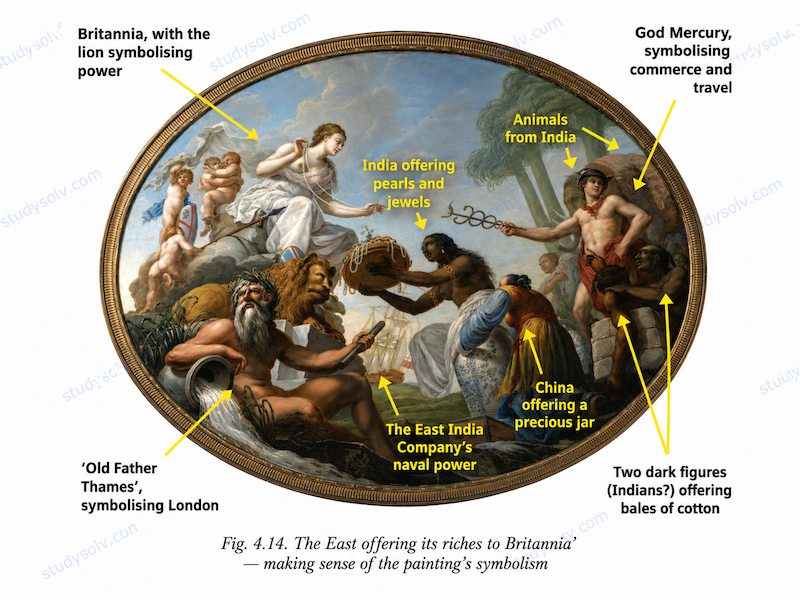
The painting 'The East offering its riches to Britannia' (1778) contains several symbolic figures. Identify the figure described below:
A seated female figure placed higher than all others, accompanied by a lion, dressed in classical robes, receiving offerings from the colonies. Who or what does this figure represent?
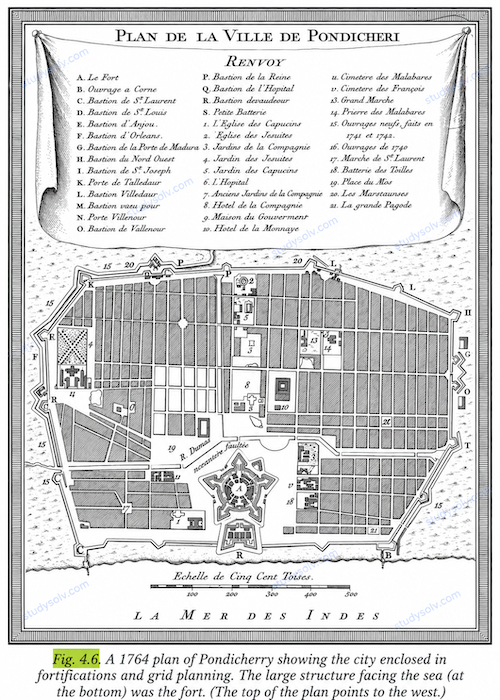
Study the 1764 plan of Pondicherry (Fig. 4.6). A large structure is shown facing the sea at the bottom of the plan. Identify what this structure is and what its purpose was.
2 Marks10 questions
What is colonialism? Give one key characteristic that distinguishes it from ordinary trade.
Who was Mir Jafar and why is his name still used as a synonym for 'traitor' in India?
What was the English East India Company, and how did it transform from a trading body into a ruling power?
What was the Indigo Revolt (1859–1862)? Name any one outcome of this revolt.
Name any two European powers that had colonial ambitions in India and identify one key difference in their approach toward Indian society.
What was the significance of the Great Rebellion of 1857? Why did historians after Indian Independence reject the term 'Sepoy Mutiny'?
What is meant by the 'drain of wealth' from India during colonial rule? Name one scholar who estimated or wrote about this drain.
Describe briefly how British policies destroyed India's indigenous textile industry.
What was the 'Sannyasi-Fakir Rebellion'? Identify one factor that triggered it.
What was the role of Begum Hazrat Mahal in the 1857 Rebellion?
3 Marks5 questions
Explain the 'divide and rule' policy of the British with two specific examples from Indian history.
How did the British colonial administration's economic policies contribute to the devastating famines in India? Give specific evidence from the chapter.
How did the British transform India's education system, and what were the long-term consequences of Macaulay's 1835 Minute on Indian Education?
Describe the causes and consequences of tribal uprisings during the colonial period with reference to any two specific examples.
What were the motivations that drew European powers to establish colonies in Asia, Africa, and the Americas during the Age of Colonialism? Explain with reference to India.
5 Marks5 questions
Describe in detail the impact of British colonial rule on India's economy, covering the decline of industries, the drain of wealth, and the transformation of the railway network. What was India's economic position before and after colonisation?
Give a detailed account of the Great Rebellion of 1857: its causes, key events, leaders, British response, and its long-term significance in Indian history.
Analyse the legacy of European colonialism in India, discussing both the negative impacts (political, economic, social, cultural) and any unintended consequences. Draw a labeled diagram or visual representation of the painting 'The East offering its riches to Britannia' and explain its symbolism.
Write a detailed account of the various European powers — Portuguese, Dutch, French, and British — that came to India, comparing their methods, motivations, and impact. Which power ultimately dominated India and why?
Examine how British colonial rule transformed the political, social, and governance structures of India, including the dismantling of traditional self-governance, changes in law, and the consequences of the 1857 Rebellion on British policy in India.
Also available for Exploring Society India and Beyond Part-I Chapter 4:
All chapters in Exploring Society India and Beyond Part-I▾
Discussion
Ask a question or share your thoughts
Leave a comment about: Exploring Society India and Beyond Part-I Chapter 4 Important Questions
💬
No comments yet. Be the first!