📚StudySolv

Class 8 · Social Science · Exploring Society India and Beyond Part-I

Chapter 4: The Colonial Era in India

ENHI
0 / 2 exercises

Exercise Let's Explore & Think About It (In-text Activities)10 Qs
Q 1analytical

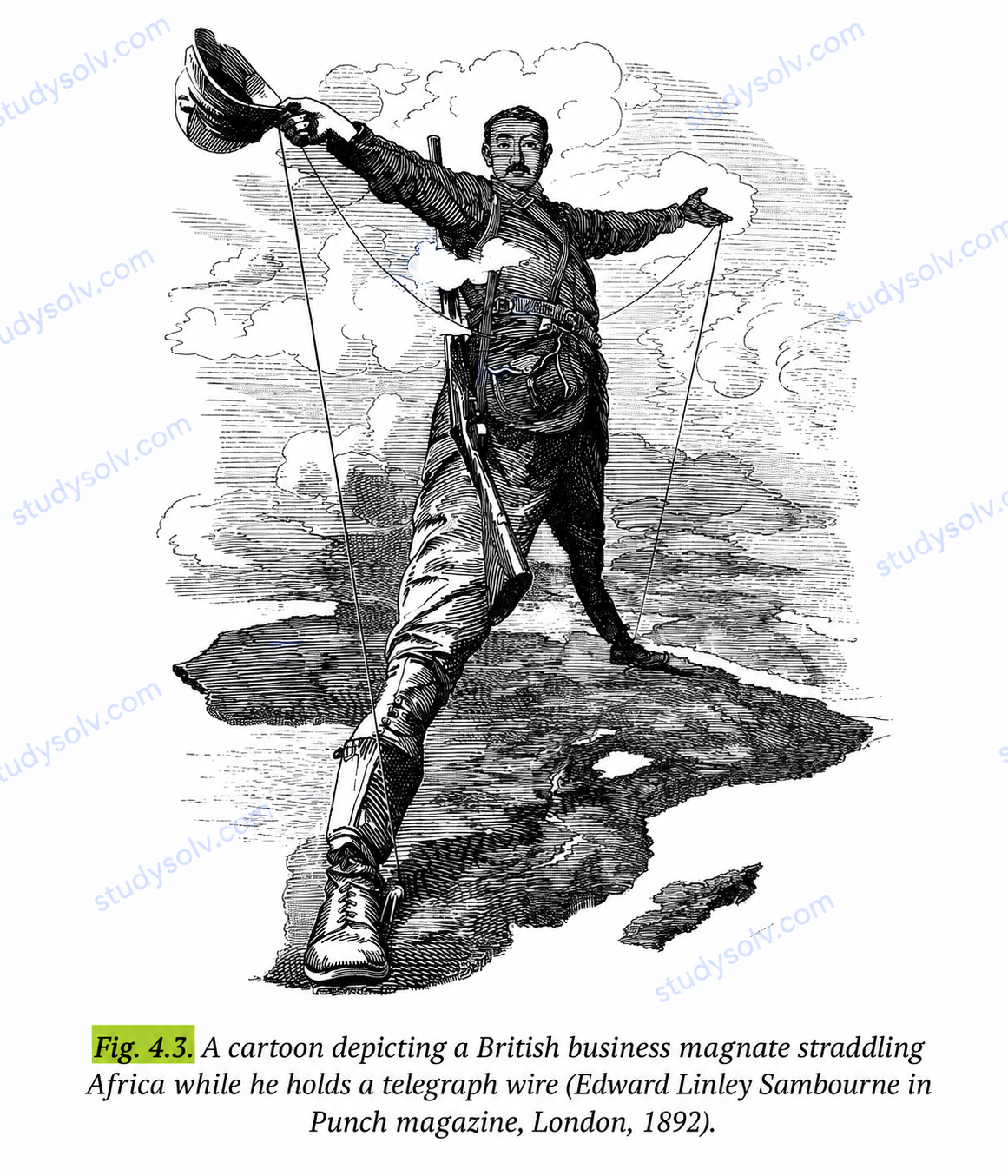
ch 4 fig 4.3

What do you think the cartoon (Fig. 4.3) is trying to express? (Keep in mind that the telegraph, which permitted instant communications for the first time, was then a recent invention.) Analyse different elements of the drawing.
Solution

The cartoon criticises British colonial expansion and greed. The magnate straddling Africa shows how Britain physically dominated and controlled the entire African continent. The telegraph wire symbolises Britain's control over communications and information — a new technology used to tighten colonial grip rather than benefit Africans. The giant figure towering over the continent suggests that one powerful person (representing British business interests) had more control over Africa than its millions of inhabitants. Overall, the cartoon is a sharp critique of British imperialism and the exploitation of colonised lands for commercial gain.

Q 2analytical

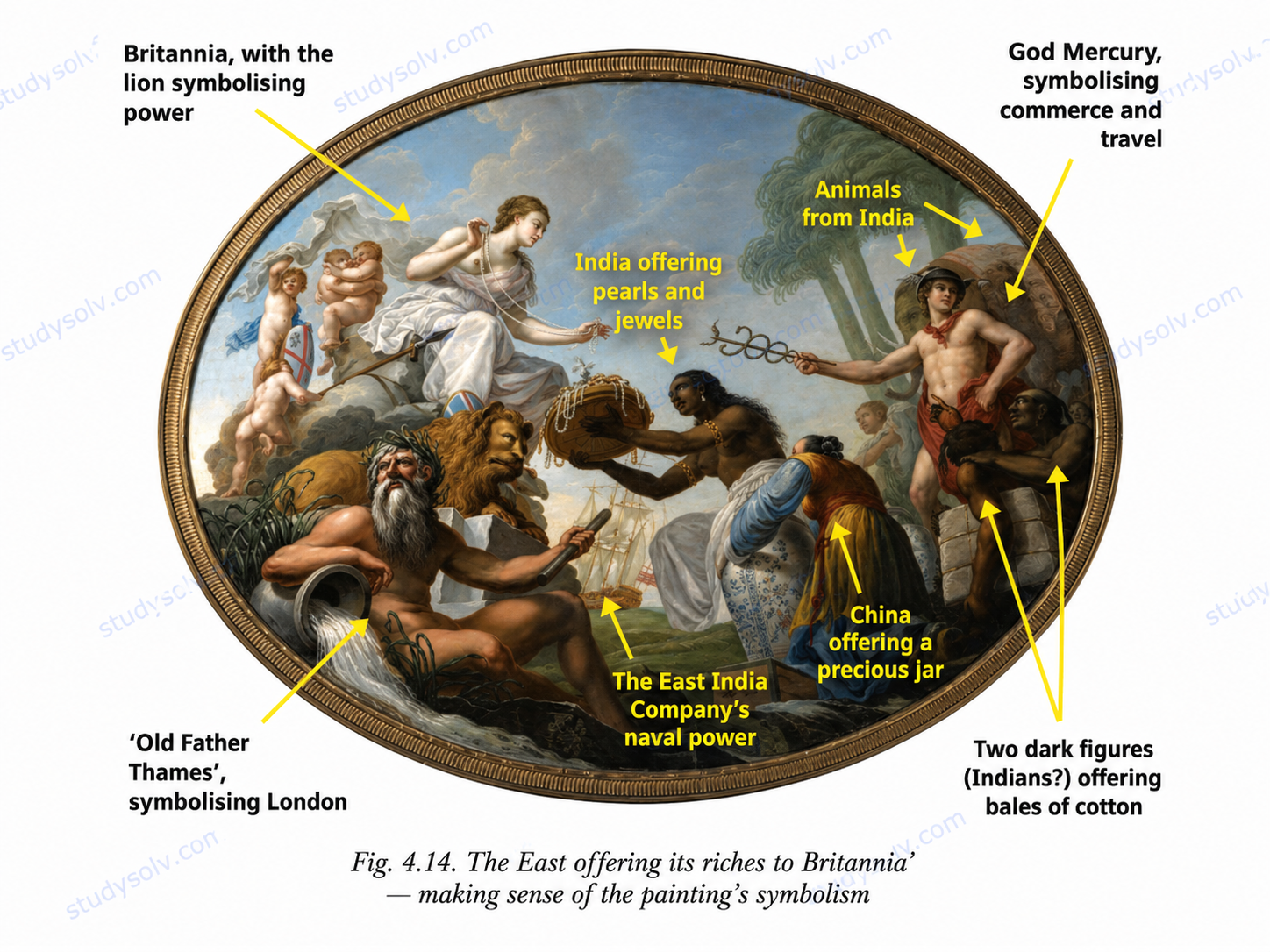
ch 4 fig 4.14

Before reading further, observe the painting 'The East offering its riches to Britannia' carefully — the people, objects, symbols, and attitudes — and present your conclusions about the messages the painting conveys.

Solution

The painting portrays Britannia (representing Britain) seated in a position of power and authority, higher than the figures from the East who appear to be offering her riches. The colonies (India, China, etc.) are shown in bent, submissive postures, suggesting that they willingly gave their wealth to Britain — which was far from the truth, as the wealth was taken by force or deception. The dark complexion of the 'Eastern' figures compared to Britannia reflects the colonial belief in racial superiority of white Europeans. The presence of animals from India, bales of cotton, pearls, and a Chinese jar reinforces the idea that the East was seen purely as a source of material wealth for Britain. God Mercury (symbolising commerce) and 'Old Father Thames' (symbolising London) complete the picture of Britain as the natural master of world trade.

Q 3short

Why do you think Dadabhai Naoroji meant by 'un-British rule in India'? (Hint: he was an MP in the House of Commons in 1892.)

Solution

Dadabhai Naoroji used the phrase 'un-British rule' cleverly to argue that Britain was not living up to its own stated values of justice, fairness, and good governance in India. As an elected Member of Parliament in the British House of Commons, he used the language of British ideals to shame Britain into recognising how its rule in India was exploitative and unjust — the very opposite of what Britain claimed to stand for. He was essentially saying: 'If you truly believe in British values of justice and fair play, then what you are doing in India is un-British.' This was a strategic argument designed to appeal to British conscience and public opinion.

Q 4short

Do you understand all the terms used above to list and describe Indian textiles? If not, form groups of four or five and try to find out more, then compare your findings with the help of your teacher.

"Do you understand all the terms used to list and describe Indian textiles (cotton, silk, wool, jute, hemp, coir, muslins, embossed fabrics)? Find out more about each in groups and compare your findings."

Solution

Cotton — a soft, fluffy fibre grown from the cotton plant, widely used for everyday cloth. Silk — a luxurious, smooth fabric made from the cocoons of silkworms. Wool — a warm fibre obtained from sheep or other animals. Jute — a coarse, strong plant fibre used for sacks and rough cloth. Hemp — a plant-based fibre used for ropes and coarse textiles. Coir — fibre from coconut husks, used for mats and ropes. Muslin — an extremely fine, lightweight cotton fabric, famous in Bengal (Dhaka muslin was legendary). Embossed fabrics — cloth with raised designs stamped or woven onto the surface, giving a three-dimensional effect. India was a master producer of all these textiles, making it a global manufacturing powerhouse before colonial rule.

Q 5analytical

What exactly did Macaulay mean when he wrote that “a single shelf of a good European library was worth the whole native literature of India and Arabia”? And why should he want to make Indians “English in taste, in opinions, in morals, and in intellect”? How does this relate to the ‘civilising mission’ mentioned at the start of the chapter? Ask your teacher to guide a class debate on these questions.

Solution

Macaulay's statement reflected his deep colonial bias — he believed European (especially English) knowledge was far superior to all Indian and Arabic learning, without having actually read any Indian texts. By wanting to make Indians 'English in taste, in opinions, in morals, and in intellect', he aimed to create a class of educated Indians who would think like the British, serve in the colonial administration, and help maintain British rule from within. This directly connects to the colonial 'civilising mission' — the false justification colonisers used, claiming they were bringing 'progress' and 'civilisation' to supposedly 'backward' peoples. In reality, it was a strategy to mentally colonise Indians alongside the physical and economic conquest, making them doubt their own culture and accept British superiority.

Q 6short

What is meant by “the sun never sets on the British Empire”? Do you think this was a correct statement?
Solution

The phrase 'the sun never sets on the British Empire' means that the British Empire was so vast, spread across so many different time zones around the globe, that at any given moment it was daytime somewhere in the empire — so the sun was always shining on British-controlled territory. This was indeed factually correct at the height of British power in the 19th and early 20th centuries, when Britain controlled territories in Asia (India), Africa, the Americas (Canada, parts of the Caribbean), Australia, and many Pacific islands. However, the statement also carried a boastful, arrogant tone, implying that this empire would last forever — which proved completely wrong, as most colonies gained independence by the mid-20th century.

Q 7short

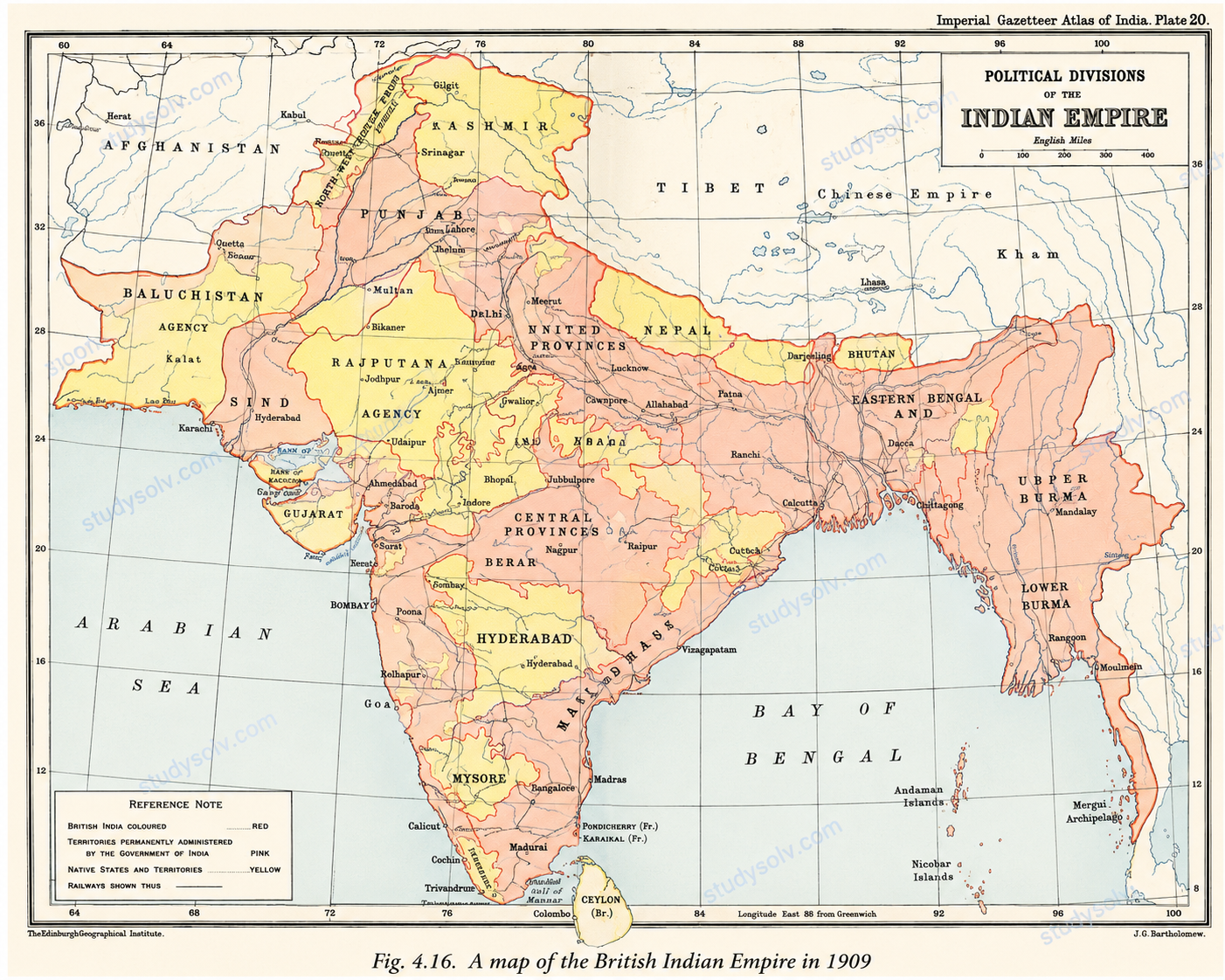
ch 4 fig 4.16

Examine the map. What are the main differences with the map of today’s India, in terms both of borders and of names?
Solution

The 1909 map of British India shows a much larger territory than today's India, as it included present-day Pakistan (undivided Punjab, Sindh, Balochistan, and the North-West Frontier Province) and present-day Bangladesh (then part of Bengal). Burma (now Myanmar) was also administered as part of British India at various points. Many place names were different — for example, Bombay (now Mumbai), Madras (now Chennai), Calcutta (now Kolkata), Simla (now Shimla), and Pondicherry (now Puducherry). The map also shows a large number of princely states (in yellow) which no longer exist as separate political units, having been integrated into India or Pakistan after Independence in 1947.

Q 8analytical

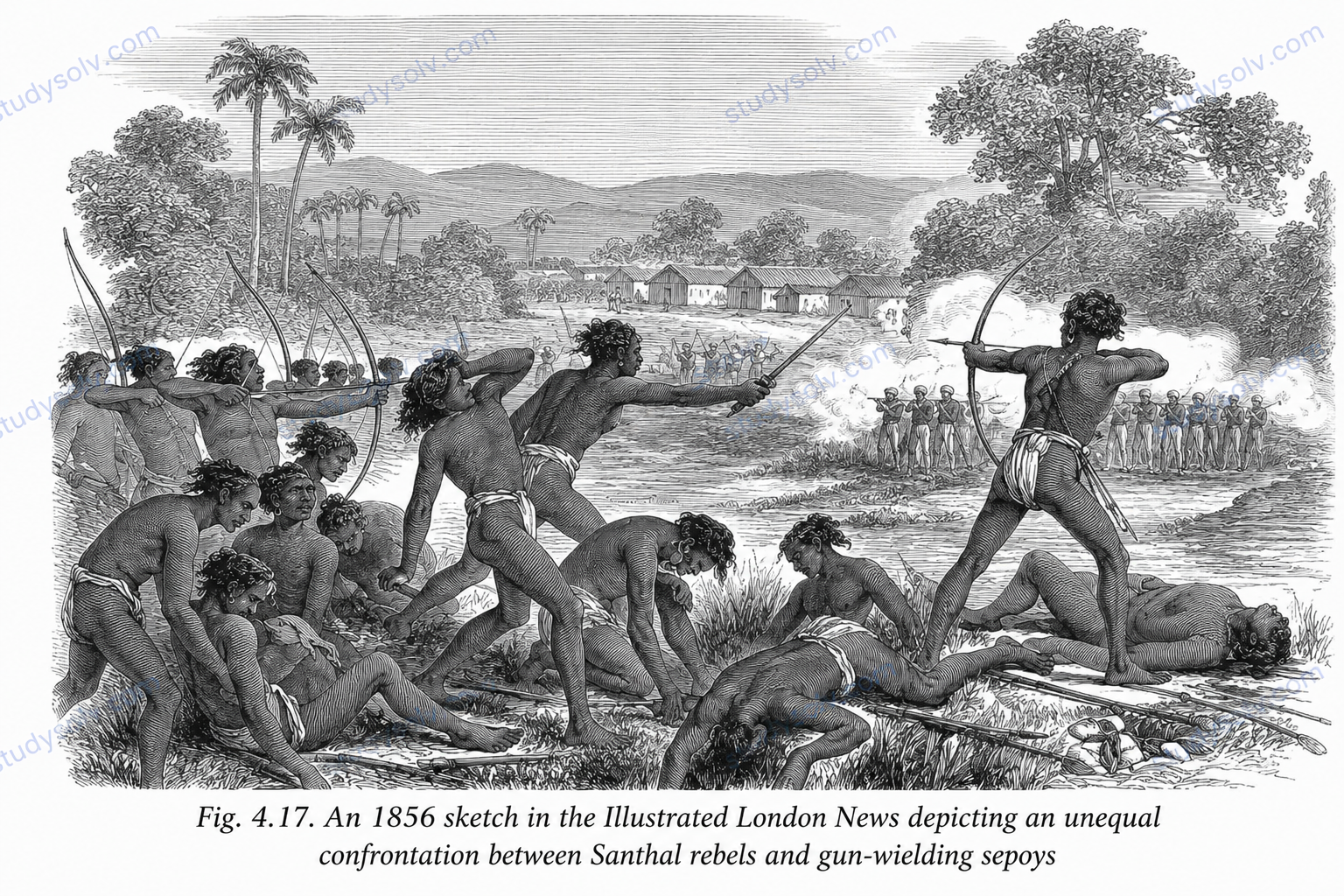
ch 4 fig 4.17

Note how the Santhals are depicted in the 1856 sketch (Fig. 4.17) drawn from an artist’s imagination: observe their complexion, dress, weapons and draw your conclusions as regards the image this depiction would create in the popular mind in Britain.

Solution

The sketch depicts the Santhals with dark complexions, minimal or 'primitive' clothing, and simple traditional weapons like bows and arrows, in sharp contrast to the gun-wielding, uniformed British sepoys. This visual contrast was deliberately designed to portray the Santhals as 'savage' and 'uncivilised' compared to the 'modern' and 'disciplined' colonial forces. In the British popular imagination, this image would justify the brutal suppression of the Santhal rebellion as necessary 'civilising' action against 'primitive' people. It reflects the colonial propaganda strategy of demonising indigenous resistance fighters to make colonial violence appear acceptable to the British public.

Q 9short

Indigo is a natural deep blue pigment used in dyeing. Can you think of other natural substances that have been traditionally used in India to dye cloth?

Solution

India has a rich tradition of using natural substances for dyeing cloth. Turmeric (haldi) gives a bright yellow colour and has been used for centuries. Madder (manjistha) produces red and pink shades. Henna (mehndi) gives an orange-brown colour. Pomegranate rind produces yellow and brown shades. Onion skins can give golden-yellow tones. Neem leaves produce greenish shades. Myrobalan (harad) is used for beige and light brown colours. These natural dyes were environmentally friendly and formed the basis of India's traditional textile dyeing industry long before synthetic dyes were invented in Europe.

Q 10short

Why do you think was the term ‘Sepoy Mutiny’ rejected after Indian Independence? Write one paragraph explaining your reasons.

Solution

The term 'Sepoy Mutiny' was rejected after Independence because it was a colonial label that deliberately minimised and distorted the true nature and scale of the 1857 uprising. The word 'mutiny' implies merely a military rebellion by soldiers against their officers, but the 1857 uprising involved not just sepoys but also civilians, peasants, zamindars, kings like Bahadur Shah Zafar, and queens like Rani Lakshmibai of Jhansi — making it a much broader popular uprising against British colonial rule. By calling it only a 'Sepoy Mutiny', the British framed it as a disciplinary problem within their army rather than acknowledging it as a legitimate and widespread resistance movement against foreign oppression. Independent India rightly recognised it as the 'Great Rebellion' or 'First War of Independence', giving it the historical respect it deserved.

Exercise The Big Questions10 Qs

Q 1definition

What is colonialism? Give three different definitions based on the chapter or on your knowledge.

Solution

Colonialism can be defined in different ways:

  1. According to the chapter: Colonialism is the practice where one country takes control of another region and imposes its political, economic, and cultural systems on it.

  2. Economic definition: Colonialism is a system in which powerful countries exploit the resources, wealth, and labour of weaker countries for their own benefit.

  3. Political and social definition: Colonialism is the domination of one country over another by controlling its government, society, education, and culture, often reducing the freedom of the local people.

Q 2short

Colonial rulers often claimed that their mission was to ‘civilise’ the people they ruled. Based on the evidence in this chapter, do you think this was true in the case of India? Why or why not?

Solution

No, the claim that the British came to “civilise” India was not completely true. The evidence in the chapter shows that the main aim of colonial rule was to control India politically and exploit it economically.

The British took India’s wealth and resources for their own benefit. Heavy taxes, exploitation of farmers, and destruction of Indian industries caused great poverty and famines. Millions of people died during famines while the British continued exporting food grains from India.

The British also weakened India’s traditional systems of governance and education. Macaulay’s education policy aimed to create Indians who were “English in taste, in opinions, in morals, and in intellect,” showing that they wanted Indians to follow British culture instead of respecting Indian traditions.

Although the British introduced railways, telegraphs, and modern administration, these were mainly developed to strengthen their control, transport raw materials, and expand trade for British benefit rather than for Indians.

Therefore, the chapter suggests that colonialism in India was more about exploitation and domination than about genuinely “civilising” the Indian people.

Q 3long

How was the British approach to colonising India different from earlier European powers like the Portuguese or the French?

Solution

The British approach to colonising India was different from earlier European powers like the Portuguese and the French in several ways.

  1. From traders to rulers: The British East India Company slowly transformed from a trading company into a political and military power. They first established trading posts and then gradually took control of Indian territories.

  2. Use of ‘divide and rule’: The British cleverly exploited rivalries among Indian rulers and communities. They supported one ruler against another, interfered in succession disputes, and used policies like “divide and rule” to strengthen their control.

  3. Political control through alliances: The British introduced systems such as the Doctrine of Lapse and Subsidiary Alliance to annex Indian states and control rulers indirectly.

  4. Economic exploitation on a large scale: Unlike the Portuguese and French, who mainly focused on trade, the British reorganised India’s economy to benefit Britain. They collected heavy taxes, destroyed Indian industries, and drained wealth from India.

  5. Long-lasting empire: The Portuguese and French controlled only limited coastal regions and trading centres, while the British eventually ruled almost the entire Indian subcontinent for nearly two centuries.

Thus, the British colonisation of India was more organised, political, and economically exploitative than the earlier European powers.

Q 4long

“Indians funded their own subjugation.” What does this mean in the context of British infrastructure projects in India like the railway and telegraph networks?

Solution

The statement “Indians funded their own subjugation” means that the British used Indian money and resources to build systems that mainly helped the British rulers strengthen their control over India.

The railway and telegraph networks were largely paid for through taxes collected from Indians. However, these projects were not built mainly for the welfare of Indians. The railways were designed to transport raw materials from villages to ports for export to Britain and to move British troops quickly to control rebellions.

Similarly, the telegraph network helped the British administration communicate rapidly across India and maintain control over the country.

Thus, Indians were forced to pay for infrastructure that mostly served British economic and military interests, helping the colonial rulers dominate India more effectively.

Q 52 marks

What does the phrase ‘divide and rule’ mean? Give examples of how this was used by the British in India?

Solution

The phrase ‘divide and rule’ means creating or encouraging divisions among people so that they remain weak and can be controlled easily by a ruler or government.

The British used this policy in India in many ways:

  1. Exploiting rivalries among Indian rulers: The British supported some kings and nawabs against others and interfered in succession disputes to increase their own power.

  2. Battle of Plassey (1757): Robert Clive secretly made an agreement with Mir Jafar, the military commander of Nawab Siraj-ud-daulah. Mir Jafar betrayed the Nawab during the battle, helping the British win Bengal.

  3. Creating divisions in society: The British encouraged tensions between different religious and social communities so that Indians would remain divided and unable to unite against British rule.

Using this strategy, the British gradually expanded and strengthened their control over India.

Q 62 marks

Choose one area of Indian life, such as agriculture, education, trade, or village life. How was it affected by colonial rule? Can you find any signs of those changes still with us today? Express your ideas through a short essay, a poem, a drawing, or a painting.

Solution

Education Under Colonial Rule

Before British rule, India had many traditional schools such as pāṭhaśālās and madrasās where students learned in their own languages and studied subjects connected with Indian culture and daily life. But during colonial rule, the British changed the education system according to their own needs.

In 1835, Thomas Macaulay introduced a new policy that promoted English education. The main aim was to create Indians who could work for the British administration. English became the language of government jobs and higher education, while many traditional schools slowly disappeared.

This change had both positive and negative effects. Modern subjects like science and mathematics spread more widely, but Indian languages and traditional knowledge lost importance. Many educated Indians became disconnected from their own cultural roots.

Even today, we can see the effects of colonial education. English is still considered important for higher studies and good jobs in India. Many schools give more importance to English-medium education, and students often feel that English is necessary for success.

Thus, colonial rule deeply changed India’s education system, and its influence continues in modern India.

Q 72 marks

Imagine you are a reporter in 1857. Write a brief news report on Rani Lakshmibai’s resistance at Jhansi. Include a timeline or storyboard showing how the rebellion began, spread, and ended, highlighting key events and leaders.

Solution

The Jhansi Chronicle

Special Report — June 1858

Brave Rani Lakshmibai Continues Fierce Resistance Against British Forces

Jhansi, Central India — Rani Lakshmibai of Jhansi has emerged as one of the bravest leaders of the Great Rebellion of 1857. Refusing to surrender her kingdom to the British under the Doctrine of Lapse, the Rani organised her army and inspired thousands to fight for freedom.

The rebellion in Jhansi intensified after Indian sepoys revolted against British officers in 1857. The British accused the Rani of supporting the uprising, though she declared that she wished to protect her kingdom and people. Soon British troops under General Hugh Rose marched towards Jhansi.

The Rani courageously defended Jhansi Fort for several weeks. Men and women fought side by side under her leadership. Even when British forces surrounded the city, the Rani escaped on horseback with her adopted son and joined rebel leaders Tatya Tope and Nana Sahib.

The struggle continued fiercely at Kalpi and later at Gwalior, where rebel forces briefly captured the city. However, in June 1858, while fighting bravely on the battlefield near Gwalior, Rani Lakshmibai was killed. Her courage and sacrifice have made her a symbol of resistance against British rule.


Timeline of the Revolt

1853

  • British apply the Doctrine of Lapse after the death of Raja Gangadhar Rao.
  • Jhansi is annexed because the British refuse to accept Damodar Rao, the adopted son, as heir.

May 1857

  • Revolt begins at Meerut and spreads across North India.

June 1857

  • Sepoys in Jhansi rebel against British officers.
  • Rani Lakshmibai takes charge of Jhansi’s administration.

March 1858

  • British forces led by General Hugh Rose attack Jhansi.
  • Fierce fighting takes place around Jhansi Fort.

April 1858

  • Rani Lakshmibai escapes from Jhansi and joins Tatya Tope.

May 1858

  • Rebel forces fight the British at Kalpi.

June 1858

  • Rebels capture Gwalior for a short time.
  • Rani Lakshmibai dies fighting bravely near Gwalior.

Important Leaders of the Revolt

  • Rani Lakshmibai — Leader of Jhansi resistance
  • Tatya Tope — Military commander and rebel leader
  • Nana Sahib — Leader at Kanpur
  • Bahadur Shah Zafar — Symbolic Mughal emperor of the revolt
Q 82 marks

Imagine an alternate history where India was never colonised by European powers. Write a short story of about 300 words exploring how India might have developed on its own path.

Solution

Here is a short alternate-history story:

India on Its Own Path

It was the year 2026, but the India of this world was very different from the one we know.

More than four hundred years earlier, European traders had arrived on Indian shores, hoping to control trade and build colonies. But the powerful kingdoms of India — the Marathas, Vijayanagara successors, Ahoms, Sikhs, and Rajputs — united through trade agreements and military alliances. Foreign powers were welcomed as traders, but never allowed to rule.

Without colonial rule, India’s industries continued to flourish. Indian textile centres in Bengal, Gujarat, and Tamil regions became world-famous manufacturing hubs. Indian shipbuilders developed massive ports along the western and eastern coasts. By the 19th century, Indian scientists and mathematicians had established universities that attracted students from across Asia and Europe.

Railways were still built, but by Indian engineers for the benefit of Indian people. They connected villages, markets, and cultural centres rather than serving foreign empires. Sanskrit, Tamil, Persian, Bengali, Marathi, and many other Indian languages grew alongside English, which remained only a language of international trade.

Village councils evolved into strong democratic institutions. Instead of wealth leaving the country, profits from trade were invested in irrigation, healthcare, and education. Famines became rare because local rulers quickly responded to crop failures.

By the 20th century, India had become one of the world’s leading economic and scientific powers. Cities like Varanasi, Mysuru, Pune, and Dhaka became centres of innovation. Ancient knowledge blended with modern discoveries.

Standing beside a solar-powered train in Mumbai, twelve-year-old Aarav smiled proudly at his school textbook. On the first page were the words:

“India’s strength came from freedom, unity, and confidence in its own civilisation.”

Q 92 marks

Role-play: Enact a historical discussion between a British official and an Indian personality like Dadabhai Naoroji on the British colonial rule in India.

Solution

Role-Play: Debate on British Rule in India

Characters:

  • Mr. Edward Hamilton — A British Colonial Official
  • Dadabhai Naoroji — Indian nationalist leader and thinker

Scene: A public meeting in London, around 1900

Mr. Hamilton: Gentlemen, British rule has brought progress to India. We have built railways, telegraphs, courts, and modern schools. We have also established law and order across the country.

Dadabhai Naoroji: But at what cost, sir? India’s wealth is being drained to Britain. Heavy taxes and unfair trade policies have made millions of Indians poor.

Mr. Hamilton: Surely you agree that British education has modernised Indian society and introduced scientific thinking.

Naoroji: Education is valuable, but your system was designed mainly to create clerks for British offices. Traditional Indian education and industries were neglected.

Mr. Hamilton: The railways and telegraphs united India and improved communication.

Naoroji: Yet Indians themselves paid for those projects through taxes. Railways mainly carried raw materials to ports and helped British troops move quickly during rebellions.

Mr. Hamilton: The British Empire has protected India from internal conflicts and foreign invasions.

Naoroji: Instead, the policy of “divide and rule” increased divisions among Indians. The British interfered in Indian kingdoms and annexed states through unfair policies like the Doctrine of Lapse.

Mr. Hamilton: Still, Britain believes it has fulfilled a civilising mission.

Naoroji: A true civilising mission does not cause famines, poverty, and exploitation. India needs self-rule so that her people can govern and develop their own nation.

Narrator: The debate ends with loud applause from Indian students and reformers. Dadabhai Naoroji’s ideas later inspire the growing movement for India’s freedom.

Q 102 marks

Explore a local resistance movement (tribal, peasant, or princely) from your state or region during the colonial period. Prepare a report or poster describing:

  • • What was the specific trigger, if any?
  • • Who led the movement?
  • • What were their demands?
  • • How did the British respond?
  • • How is this event remembered today (e.g., local festivals, songs, monuments)?

Solution

Report on the Revolt of 1857 in Meerut (Uttar Pradesh)

Name of the Movement

The Revolt of 1857 (Meerut Uprising)

Region

Meerut, Uttar Pradesh


What was the specific trigger?

The immediate trigger was the introduction of the new Enfield rifle cartridges. Indian sepoys believed the cartridges were greased with the fat of cows and pigs.

  • This hurt the religious feelings of both Hindus and Muslims.
  • Soldiers had to bite the cartridges before loading them into rifles.

When 85 sepoys refused to use them, the British publicly punished and imprisoned them on 9 May 1857. This insult and humiliation led to anger among soldiers and common people.

On 10 May 1857, the soldiers revolted against British rule in Meerut.


Who led the movement?

The revolt in Meerut was mainly started by Indian sepoys. Important leaders connected with the wider Revolt of 1857 included:

  • Mangal Pandey
  • Bahadur Shah Zafar
  • Rani Lakshmibai
  • Nana Sahib
  • Tatya Tope

What were their demands?

The rebels wanted:

  • Freedom from British rule
  • Respect for Indian religions and traditions
  • End of unfair British policies
  • Restoration of Indian rulers and kingdoms
  • Better treatment of Indian soldiers

How did the British respond?

The British used strong military force to crush the revolt.

  • Many rebels were arrested or executed.
  • Villages and towns supporting rebels were attacked.
  • After suppressing the revolt, the British ended the rule of the East India Company in 1858 and brought India directly under the British Crown.

How is this event remembered today?

The Revolt of 1857 is remembered as India’s First War of Independence.

Today it is remembered through:

  • Shaheed Smarak (Martyrs’ Memorial) in Meerut
  • School programs and Independence Day celebrations
  • Patriotic songs and stories about freedom fighters
  • History books and local cultural events
  • Statues and memorials of leaders like Rani Lakshmibai and Mangal Pandey

The bravery of the rebels continues to inspire people across India.