Class 9 · Science · Exploration
Chapter 3: Tissues in Action
Exercise Think It Over3 Qs
How is the study of cells and tissues significant for understanding the life processes and human welfare?
How are tissues in plants and animals different, and why?
How is the division of labour at various levels of organisation in multicellular organisms correlated with their structure and function?
Exercise Activity 3.11 Q
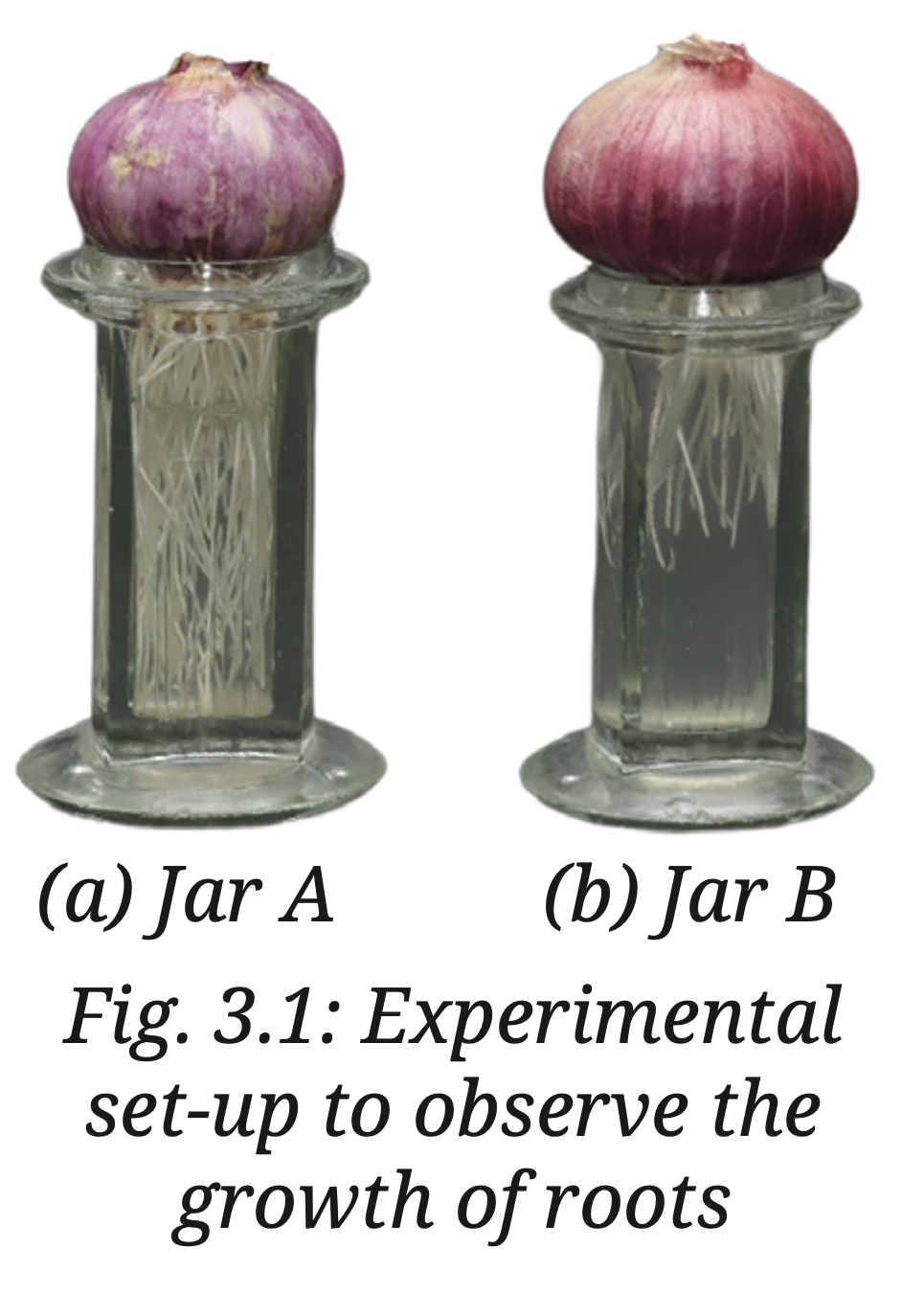
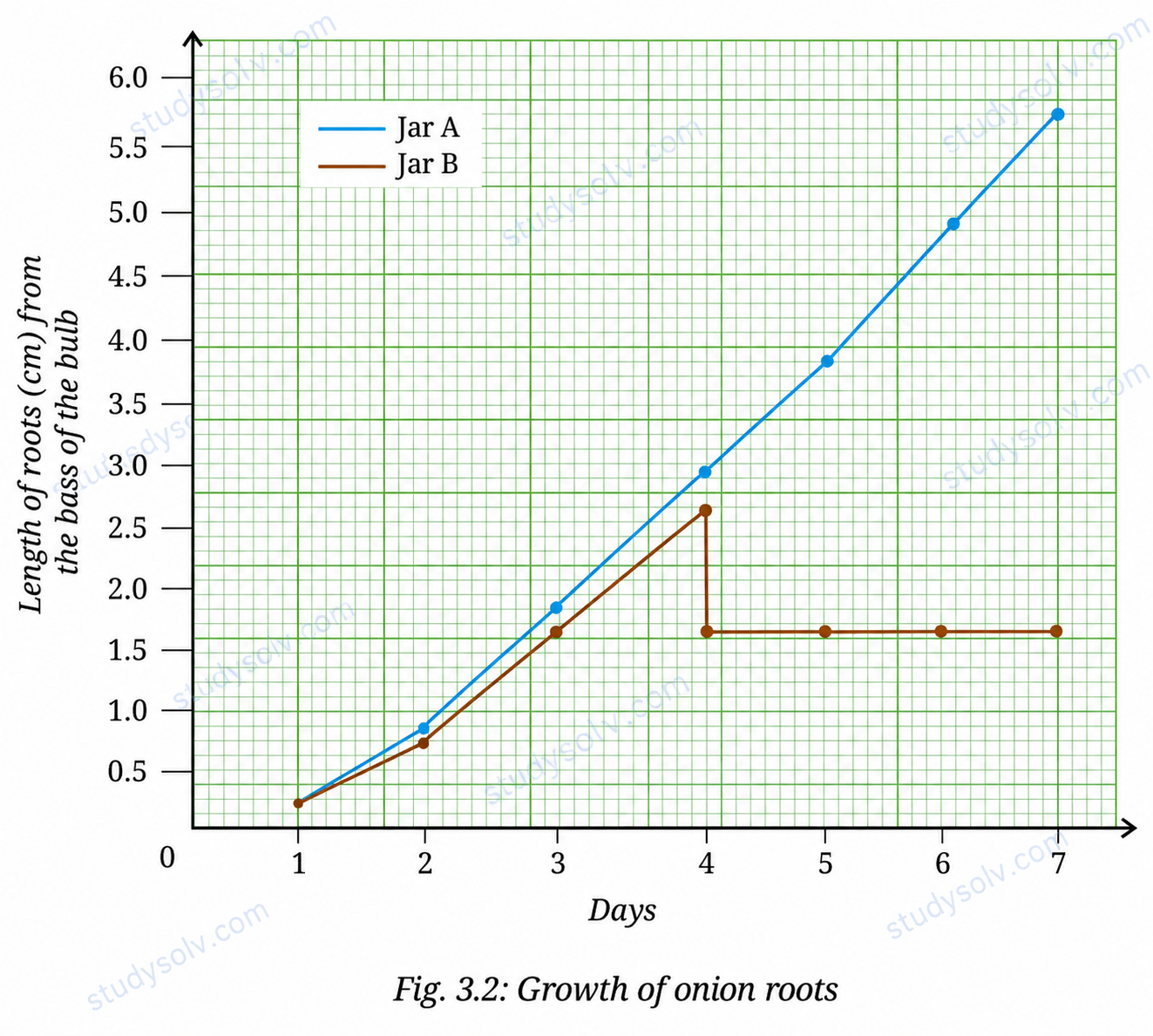
What trend do you observe in the data from the root growth experiment? Are your observations similar to the graph in Fig. 3.2? What do you infer from this?
Exercise Pause and Ponder (Plant Tissues)4 Qs
Coconut husk fibres are hard and brittle, while coriander leaf stalks are soft and flexible. What is the reason for this difference?
Why is a thick cuticle on the epidermis beneficial for desert plants but harmful for aquatic plants?
Water absorbed by plant roots must travel upward against gravity through xylem. How do the dead xylem cells work with the living leaf cells to keep water moving?
What would happen if there were no stomata in the epidermis of stems or leaves?
Exercise Activity 3.22 Qs
Question: When you get a skin infection
Question: When you exercise or run
Exercise Activity 3.31 Q

Perform the actions in Table 3.4, record your experiences, and identify the connective tissues involved based on Fig. 3.12.

Exercise Activity 3.41 Q
- 1.Step on a weighing scale and record your total body weight.
- 2.Use online references or health resources to find average bone and muscle mass percentage for your age, gender, and an Indian body type (these may vary by ethnicity). For example, on average, adult males have about 40 – 50 per cent muscle, and adult females have ~30 – 40 per cent muscle, although bone mass is about 12 – 15 per cent for all adults.
- 3.Multiply your total body weight by the bone percentage and muscle percentage to estimate the weight of your bones and muscles.
- 4.Record the estimated bone weight and muscle weight, and compare them with your total body weight.
- 5.Compare your findings with those of your classmates and calculate the class average. Discuss why do bone and muscle mass differ between individuals, and how do they contribute to the overall body weight?
Exercise Activity 3.52 Qs

Move different parts of your body and observe the type of movements each part can make.

What actually causes bones to move?
Exercise Pause and Ponder (Joints and Dance)1 Q
Look at the various poses of classical and folk dances of India in Fig. 3.17. Can you identify which joints are involved and what type of movement each joint allows?

Exercise Questions based upon Table 3.64 Qs

What do you conclude about the characteristics of phloem cells of carrot?
In which of the three combinations would you obtain the highest and lowest biomass? What could be the possible reason(s) for this observation?
Will you get the same results if you culture animal cells instead of carrot cells?
Think and mention any two commercial applications of the study above.
Exercise Revise, Reflect, Refine18 Qs
Meristematic tissues divide repeatedly. Which property of their cells allows them to do this?
- (i) They have thick walls for protection.
- (ii) They contain large vacuoles that store nutrients.
- (iii) They have thin walls, dense cytoplasm and large prominent nucleus.
- (iv) They are functionally differentiated cells.
If a plant is unable to transport food from leaves to roots which tissue is malfunctioning?
- (i) Xylem
- (ii) Phloem
- (iii) Epidermis
- (iv) Sclerenchyma
Why are the epithelial tissues that line an animal’s internal organs usually only one or a few cells thick?
- (i) To store food efficiently.
- (ii) To provide maximum strength.
- (iii) To allow quick exchange of materials across them.
- (iv) To reduce friction.

You can perform these two jumps (Fig. 3.21):
- Straight-leg jump — keep knees and ankles stiff.
- Normal jump — bend knees and ankles naturally.
- How did your ankle, knee and hip positions differ between the two jumps?
Which type of joint is involved when you bend your knees and ankles?
- (i) Ball and socket
- (ii) Hinge
- (iii) Pivot
- (i) Both (A) and (R) are true, and (R) is the correct explanation of (A).
- (ii) Both (A) and (R) are true, but (R) is not the correct explanation of (A).
- (iii) (iv) (A) is true, but (R) is false.
- (A) is false, but (R) is true.
Assertion
- (A): Epithelium is well-suited for gas exchange in the lungs. Reason
- (R): It consists of multiple layers of tall cells that slow down diffusion.
Assertion
- (A): Cardiac muscle can contract continuously without fatigue. Reason
- (R): Cardiac muscle cells have a high number of mitochondria and an abundant blood supply.
Assertion
- (A): Tendons connect bone to bone and allow joint movement. Reason
- (R): Tendons are made of tough connective tissue that transmits force from muscle to bone.
Assertion
- (A): In a hinge joint, movement occurs primarily in one plane. Reason
- (R): The bone ends are shaped to allow sliding in all directions.

Plot a graph between the age of a tree (in years) on the x-axis and the diameter of the tree (in cm) along with the number of annual rings formed over time on the y-axis, using the data given in the Table 3.7. Then answer:
- (i) Analyse the graph in terms of the diameter of the stem over time and share the interpretation.
- (ii) What is the relation between the diameter of the teak tree to the annual rings formed?
- (iii) Which specialised tissue is responsible for the girth of the stem and where is it located?

In a forest, it was observed that one of the trees was severely debarked by an elephant to meet its food requirements, as the bark is a rich source of nutrients (Fig. 3.22). Based on your learning, answer the following:
- (i) Which function(s) of the tree is/are hampered by debarking?
- (ii) Which plant tissue would be affected by further damage to the tree trunk even after debarking?
- (iii) Which function of the tree would be hampered if the tissues beneath the bark were severely damaged?
- (iv) What assumptions are you making to answer the questions above? How would the answer change if your assumptions are also changed?
Aamrapali observed that a young mango sapling’s stem bends flexibly during monsoon winds and does not break. Which tissue is responsible for this flexibility? Predict and provide your explanation of the impact if the existing tissue was replaced by sclerenchyma.

Sohan designed an experiment for the regeneration of sugarcane, where he used cuttings to grow sugarcane. He used two types of cuttings, type ‘A’ and type ‘B’ (Fig. 3.23). After a few weeks, type ‘B’ cuttings sprouted and developed into sugarcane plants, whereas the type ‘A’ cuttings did not sprout.
- (i) Why were the type ‘B’ cuttings able to grow as sugarcane but type ‘A’ could not?
- (ii) What difference was present in type ‘B’ compared to type ‘A’?
- (iii) What observation or measurement was made to determine whether this change had an effect?
- (iv) What parameters should be kept the same for both types of cuttings to ensure a fair comparison?
During the discussion in class, Rohan gives a statement that, “A tissue is a group of similar cells performing similar functions”. But Rajiv counter argues that, “this is true in case of simple tissues but little different in case of complex tissues”. Provide your explanation in view of the discussion in class.
Coconut husk fibres are used for mats which are tough and fibrous. Which tissue has structural features suitable for providing this strength? Explain why living parenchyma couldn’t serve the same purpose.
Vibha claims to her friend Neha that, “Meristematic cells are located only at the root and shoot apices”. What do you think about this statement? What question can Neha ask Vibha to help her understand further if the statement is incorrect?
A plant cell and an animal cell are of the same size.
- (i) Which cell will have a larger vacuole? Give reasons.
- (ii) What assumptions are you making to answer the question above?
A textbook states, “Each plant tissue performs only one specific function”. What questions would you ask to critically examine the correctness of this statement? What examples of tissues would you take to find out the answers to these questions?
Exercise The Journey Beyond6 Qs
Visit a doctor and find out what happens in ligament rupture, cartilage rupture and fracture of bones. How can we reduce the risk by changing our lifestyle and nutritional balance?
Perform the following activity.
- (i) Sit with your feet flat on the floor.
- (ii) Place your fingers on the back of your ankle just above the heel (Fig. 3.24).
- (iii) Point your toes down and up, and you will feel the tendon moving. Tendons are designed to withstand huge pulling forces. Try exploring other tendons in your body around the different joints.

Reflect on any of the physical practices you are familiar with, such as yoga, kabaddi, etc. How would it support bone and muscle health?
Reflect on any gardening methods you know, such as pruning, grafting, irrigation or crop rotation. How does each practice support the healthy functioning of plant tissues like meristems, conducting tissues or supporting tissues?
Turn a nature walk into a research project.
- (i) Observe different leaves and study their adaptations for various environments, such as desert, very moist or aquatic habitats.
- (ii) Consult an elder community resource persons about their knowledge on different plant leaves, such as leaves that remain fresh for a long time, repel water or deter insects. Find out their traditional uses, such as making plates, preparing cooling wraps or functioning as insect repellents.
Study various dance forms of different tribal communities across the country. Each student learn and experience at least five steps. Observe the joint movements involved in performing these steps and then develop a dance or drama on the concept of joint movements. Perform this at the school’s annual function so that students from different grades can learn from it.

Exercise The Quest Continues1 Q
Will it be possible to obtain a complete animal from an animal cell like plants? If yes, what would be the advantages and challenges of this development?
Also available for Exploration Chapter 3:
Discussion
Ask a question or share your thoughts
Leave a comment about: Exploration Chapter 3: Tissues in Action
💬
No comments yet. Be the first!